Shopify Jewelry Stores: Measuring Email Marketing Attribution With Attribuly
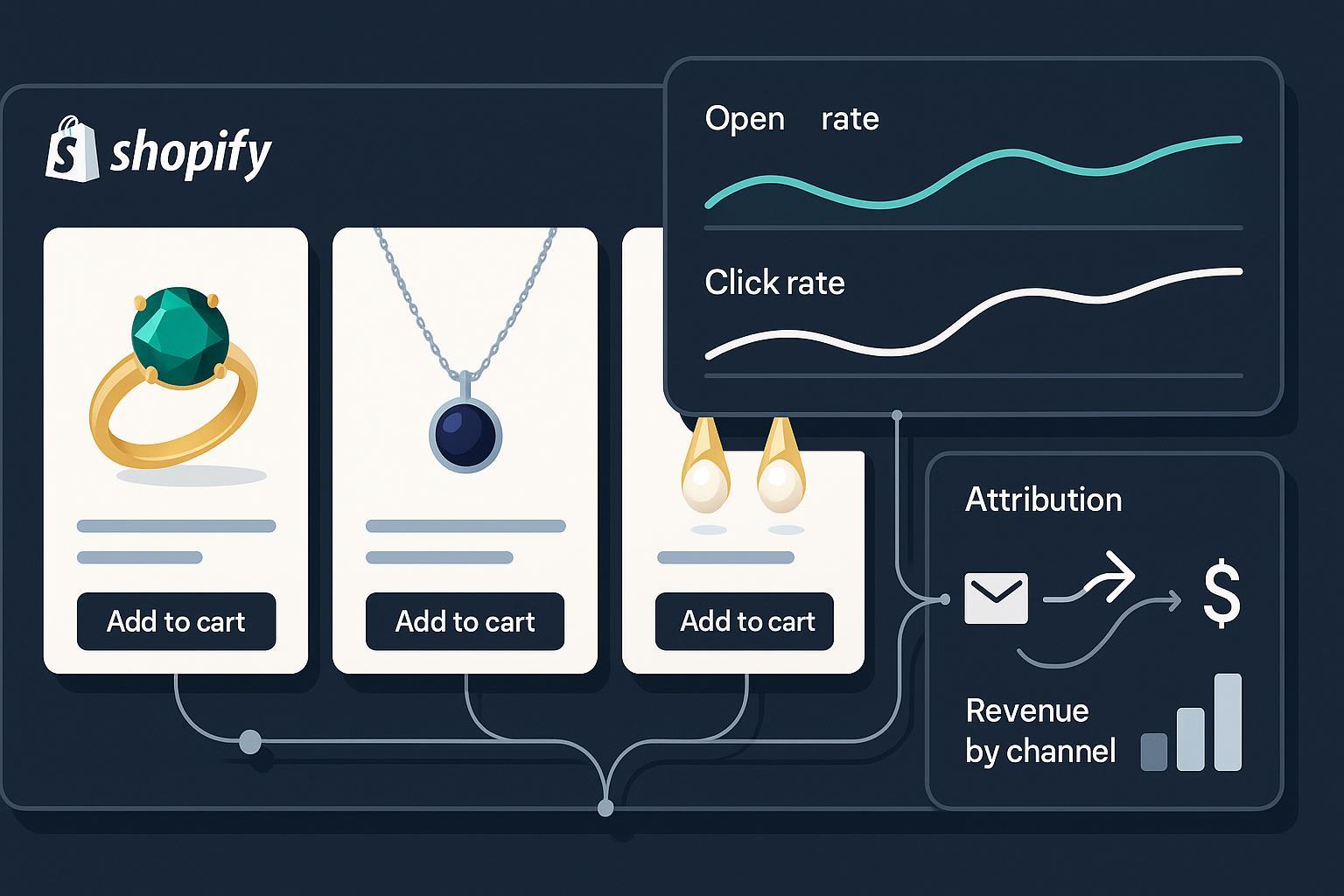
Email is often the quiet workhorse in jewelry ecommerce: it nudges gift researchers, reassures high-AOV buyers about materials and certifications, and closes the loop on abandoned carts. Yet proving its revenue impact is tricky because customers bounce across devices, ads, and content before they purchase. This guide distills field-tested steps to measure email’s true contribution in Shopify jewelry stores—so you can make smarter budget and lifecycle decisions.
What actually improves attribution accuracy (and why it matters in jewelry)
- Use multi-touch attribution to reflect reality. Single-touch models routinely undervalue email’s “assist” role. Shopify’s 2025 explainer outlines how position-based and time-decay models better distribute credit across touchpoints; see the overview in Shopify’s 2025 guide to multi-touch attribution.
- Rely on cross-device identity, not just cookies. Jewelry journeys span mobile browsing and desktop buying; stitching these together requires durable identifiers (e.g., hashed email, customer ID). For a practical view of cross-device tracking needs in 2025, see Usercentrics’ cross-device tracking guide (2025).
- Add server-side tracking to reduce data loss. Privacy features and blockers can break client-side pixels; server-side events help close gaps and improve attribution completeness, as summarized in Invoca’s 2025 multi-touch attribution guide.
- Standardize UTMs in every email link. Consistent utm_source/medium/campaign/content values turn scattered clicks into coherent journeys you can attribute and analyze reliably.
Step-by-step workflow: Shopify + Klaviyo + your attribution platform
These steps assume you run Shopify and Klaviyo. Replace “your attribution platform” with your tool of choice during setup.
- Install and verify Shopify tracking
- Install the app from Shopify’s App Store and complete app permissions.
- Confirm baseline events (product view, add-to-cart, checkout started, purchase) and order data are flowing. Align timezone/currency.
- Enable identity resolution and server-side events
- Turn on server-side or web-pixel-based event capture.
- Ensure identifiers (hashed email, Shopify customer ID) are collected to unify cross-device activity and reduce anonymous traffic.
- Connect Klaviyo and map events
- In your attribution platform, connect Klaviyo and select events to forward (product_viewed, add_to_cart, checkout_started, purchase).
- In Klaviyo, duplicate your core flows (browse/cart abandonment, price drop, back-in-stock). Add filters so Attributed events won’t double-trigger existing flows.
- Enforce a UTM policy in email templates
- Recommended defaults: utm_source=klaviyo, utm_medium=email, utm_campaign={{campaign_name}}, utm_content={{variant}}.
- Add a QA-only parameter like attrib=true on staging links to validate routing. Store UTMs server-side when possible (e.g., order notes) to preserve source data even when client-side scripts fail.
- Set attribution windows and compare models
- Start with your email platform’s default click window (often ~5 days). In jewelry, test extending flows to 7–14 days due to longer consideration cycles. Note that some platforms recalculate historical revenue when you change windows; in 2024–2025, Klaviyo documented such behavior in its attribution model updates to reporting.
- In your attribution tool, compare last-click vs time-decay and position-based to quantify email’s assist role alongside paid and organic.
- Build jewelry-specific segments and flows tied to measurement
- Gift intent: behaviors like wishlist, gift guide pageviews, and seasonal timing (Valentine’s, Mother’s Day, December deadlines). Track revenue per recipient and assisted conversions.
- High-AOV/VIP: purchasers above threshold (e.g., $300+), frequent buyers, or premium materials. Measure incremental revenue from education and financing messaging.
- Style/collection affinity: based on browse and click patterns (e.g., gold vs silver, minimal vs statement pieces). Attribute cross-sell and upsell touches.
- Milestone/anniversary: purchase date-driven reminders with care content; watch time-to-convert and repeat order contribution.
- QA and reconcile platform differences
- Expect Shopify (closer to last-click) to differ from Klaviyo (windowed attribution) and your multi-touch reports. Document which model each team relies on, and re-state expectations when switching views. For common deltas and how to interpret them, see this 2025 discussion on Shopify vs GA tracking gaps from Littledata.
- Monitor privacy impacts. Apple’s Mail Privacy Protection inflates opens; prioritize clicks and conversions for performance decisions. Twilio’s 2025 overview recaps the core effects in Apple Mail Privacy Protection impacts (2025).
Workflow in practice — Example (Attribuly)
Meet Attribuly, a marketing attribution and tracking platform built for ecommerce. Disclosure: the example below references the vendor’s published resources.
A DTC brand using Attribuly’s Klaviyo integration and server-side identification saw email’s revenue share rise rapidly after activating browse/cart triggers and identity recovery. In the consumer electronics case “Sylvox,” the team reported a 5x ROI improvement and $2.8M in additional revenue, with email revenue share increasing from 17% to 29% within four weeks; details are documented in the Attribuly case study on Sylvox (case page). While jewelry buying cycles differ from electronics, the mechanism—server-side signals feeding Klaviyo flows plus multi-touch measurement—is analogous. In practice, Shopify jewelry merchants should expect lift to vary by AOV, seasonality, and list quality.
Reporting that actually drives better decisions
- Watch assisted conversions and journey paths. A rise in email’s assisted revenue under time-decay/position-based models usually indicates effective pre-purchase education and reminders.
- Monitor time-to-convert after email. For jewelry, healthy ranges are often longer than in low-AOV verticals; a gradual elongation can signal more research behavior or misaligned offers.
- Compare contribution by segment/flow. If gift-intent flows over-index on assists vs. direct conversions, keep funding upper-funnel content and deadline reminders.
- Align budgets with model insights. If last-click underreports email vs multi-touch, resist the urge to cut email spend; instead, validate with holdouts where feasible.
For a deeper look at multi-touch models and journey mapping, review the Attribuly attribution product overview and align the metrics you present in weekly business reviews with the same model family.
Segmentation and flow recipes for jewelry (measurable and scalable)
- Gift-buyer detection
- Triggers: gift guide views, “gift packaging” clicks, seasonal gift banners, wishlists created, shipping cutoff pages.
- Messaging: deadlines, gift receipts, extended returns, premium packaging.
- KPI focus: assisted revenue, revenue per recipient, last non-direct touch share.
- High-AOV / VIP nurture
- Triggers: AOV > $300, repeat buyers, financing pageviews.
- Messaging: certifications, materials provenance, sizing guides, financing options, concierge chat.
- KPI focus: time-decay credit share, time-to-convert, average order uplift.
- Material/collection affinity
- Triggers: repeated views of specific metals/gem types, product tags.
- Messaging: care guides, matching pieces, style lookbooks.
- KPI focus: cross-sell rate, assisted revenue on bundles.
- Milestone/anniversary automation
- Triggers: 6–12 months post-purchase, ring sizing adjustments, warranty registrations.
- Messaging: care refreshers, upgrade suggestions, engraving reminders.
- KPI focus: repeat order rate, attribution shift from paid to owned.
Troubleshooting: fast fixes for the most common gaps
-
“My email platform and Shopify don’t match revenue.”
- Expect differences: attribution windows, click/open logic, and last-click bias vary. Write down your “source of truth” by use case (e.g., lifecycle creative optimization uses multi-touch; finance rollups use Shopify’s orders). If windows change, communicate recalculation impacts (see Klaviyo’s 2024–2025 note on attribution model updates).
-
“Opens look great; conversions don’t move.”
- Apple MPP inflates opens. Shift emphasis to click-through and placed order metrics and use modeled conversions where available. Twilio’s 2025 recap of Mail Privacy Protection impacts explains why.
-
“UTMs are inconsistent across links.”
- Lock your template variables; use a branded link builder or QA checklist. Consider storing UTMs server-side to reduce loss if client tracking is stripped.
-
“We’re seeing anonymous sessions and cross-device duplication.”
- Ensure hashed email capture on sign-up and checkout, and pass Shopify customer IDs where permitted. For cross-device unification rationale, review Usercentrics’ 2025 cross-device guidance.
-
“GA and Shopify differ wildly.”
- It’s common, especially with client-side gaps. Server-side event pipelines can mitigate this; for background on 2025 nuances, see Littledata’s analysis on Shopify vs GA tracking.
Privacy and consent you can defend
Jewelry stores often expand into multiple regions; your email attribution must honor regional rules. At minimum, disclose UTMs/pixels/server-side attribution, provide retention periods, and offer opt-out where required. The California Attorney General’s official page summarizes obligations under the CCPA (California Consumer Privacy Act); if you operate in the EU, apply GDPR-grade consent and preference management. Compliance protects trust and improves data integrity over time.
How to analyze weekly inside your platform
- Email revenue contribution by model: compare last-click vs time-decay or position-based and capture how assists change allocation.
- Assisted conversions and top paths: identify which flows (e.g., gift deadlines, education) appear in converting journeys.
- Time-to-convert and decay windows: ensure your window length reflects real cycles; in jewelry, test 7–14 days for flows and re-evaluate quarterly.
- Segment-level ROAS and RPR: track revenue per recipient (RPR) and ROAS for VIP and affinity segments; move budget toward segments with strong assist value.
If you’re connecting Klaviyo events through server-side signals, confirm the mapping and triggers described in the Attribuly Klaviyo integration explainer so lifecycle reports include those touches.
Quarterly audit checklist (copy-paste into your ops runbook)
| Area | Check | Pass signal | Action if fail |
|---|---|---|---|
| Identity | Hashed email + Shopify customer ID captured | Cross-device sessions consolidate; lower anonymous rate | Add capture on signup/checkout; verify hashing and mapping |
| Events | product_viewed, add_to_cart, checkout_started, purchase firing server-side | Event logs match Shopify orders within small variance | Reconnect app; verify web pixel permissions; compare client vs server logs |
| UTMs | utm_source/medium/campaign/content standardized in all templates | No “(not set)” or miscoded campaigns in reports | Lock templates; add link builder; store UTMs server-side |
| Windows | Email click window set appropriately (7–14 days tested for flows) | Stable attribution and believable time-to-convert | A/B windows per flow; document changes; notify stakeholders |
| Models | Last-click vs time-decay/position-based reviewed | Budget decisions reference multi-touch insights | Add assisted revenue to WBR; run monthly model comparison |
| Klaviyo | No double-triggering; suppression rules clean | Flow sends match event volume; low duplicate alerts | Add flow filters; QA test profiles; dedupe events |
| Privacy | Disclosures and opt-outs verified; region logic tested | CMP firing; requests honored within SLA | Update privacy policy; test DSAR workflows; legal review |
Recap — where these best practices land you
- Your measurement reflects real jewelry journeys, not just last clicks.
- You’re set up to capture the server-side signals that power better flows and more accurate attribution.
- You can explain why numbers differ across tools and choose the right model for the question at hand.
If you want to see how a dedicated ecommerce attribution platform structures these reports and models, skim the Attribuly attribution product overview and the Shopify-focused setup on the Attribuly Klaviyo integration page. For a quantified outcome in another DTC vertical, the Sylvox case study outlines the mechanics behind lift. Finally, if you’re installing from Shopify, review the permissions and web pixel approach described on the Attribuly Shopify integration page.
Sources and further reading (select)
- Shopify’s 2025 overview of multi-touch attribution types and tips (2025)
- Usercentrics’ 2025 guidance on cross-device tracking (2025)
- Invoca’s 2025 summary of server-side benefits for MTA (2025)
- Klaviyo’s note on attribution model updates to reporting (2024–2025)
- Twilio’s overview of Apple Mail Privacy Protection impacts (2025)
- Littledata’s analysis of Shopify vs GA tracking issues (2025)
- California OAG’s CCPA official page (accessed 2025)